Home » Archives for John Scott Tynes

Author: John Scott Tynes

Let’s Rumble article for the Feng Shui RPG

I originally wrote this article for Steve Jackson Games’ magazine Pyramid circa 1996, where I believe it was published under the title “Blowing Things Up.” A Feng Shui GM asked me about this recently so I thought I’d dig it out of my files and post it here.


Let’s Rumble

TEN COOL PLACES TO HAVE A BIG FIGHT IN THE FENG SHUI RPG

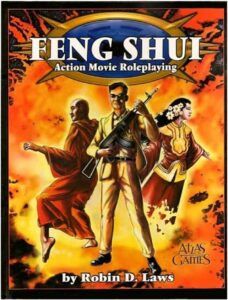
Feng Shui RPG Book Cover

(C)1996 John Tynes

“It’s going down tonight, Ringo. Big Trousers Garcia and the boys from Capture Squad Capybara are gonna be there. They’ve gotta be stopped!”

“We’ll be there with bells on, don’t worry. But where’s it happening?”

“That’s the thing. You’ll never believe this…”

Where is it happening? Is it a public place? A private residence? Are there enough doors and windows for hordes of mooks to come blazing through? Could hordes of mooks even be there in the first place? What cool stuff is available for the big fight scene that is bound to happen as soon as Garcia lights his cigar and says “Teach ’em a lesson, boys!”?

In Feng Shui, big honking fight scenes are the mayonnaise that binds the double-pastrami-on-rye of your scenario together. How many cool places to stage a big fight scene can you come up with on the fly? In case your creative juices are all squeezed out, here’s ten quick suggestions for excellent situations just begging for excessive gunfire and a squad of roaring abominations to shake things up. These locales are all set in the contemporary juncture, but most could easily be converted to the other time periods in the game. Use ’em, abuse ’em, and make up more on your own. When the feng shui hits the fan, you’ll be ready to craft the things-blowing-uppest scene your players have seen since…well, since the last time they played Feng Shui. Lock and load, secret warriors!

One: The Island Refuge

The evil Dr. (fill in the blank) has a secret island retreat. A big mansion, a warren of secret tunnels and control rooms, little jeeps to zip through the muddy roads, and a bunch of big, wild predators stalking the jungle—these are the elements you’ll have at hand when the PCs show up and set off the plastique. After all, five hundred mooks in orange jumpsuits can’t be wrong!

The PCs will probably arrive in one of two ways: either as guests or as intruders. If they’re there as guests, they may be undercover or they may be “guests” brought there at gunpoint. Regardless, Dr. Whatsisname has a lavish dinner for them just before he turns on the death traps and has Hit Squad #13 (collect them all!) line up outside the front door for the big hunt—with the guests as the prey. If the PCs are there as intruders, they get to do all that cool commando stuff: slipping up to the beach in inflatable rafts, defeating the security system, avoiding the tigers, taking out the sentries, and so on. Of course, they might just nuke it from orbit—but where’s the fun in that?

Cool Stuff:

  • Lee Marvin city! Jump from palm trees, leap out of bushes, stand in the back of a jeep firing away while your buddy drives, or just throw someone into the electric fence.
  • There’s gotta be a big pit of venomous snakes in the jungle fight scene. Toss someone in, or grab a big handful of snakes and toss them into a passing jeep full of mooks.
  • Blow the generators. The secret warren of tunnels is guaranteed to have some sort of big power system that can be quickly rigged to blow up the whole island. Even better, there could be an active volcano that powers the facility (don’t ask how) and that can be set off with some chewing gum and a paper clip.

Two: The Museum

A classic place for mooks to use as a drop point. They’ve got a gym bag full of heroin or arcanotech gear or the latest issue of Guns & Ammo to swap in exchange for a briefcase full of cash. The PCs are there to blow the deal. Bystanders are everywhere, and all those glass display cases—well, you know!

Museums are also great places to add a little Thematic Unity. Is it a Lotus meet? Stage it in a room with treasures from the early dynasties of China. Are Buro agents present? Presto, it’s a po-mo virtual reality kinetic sculpture altered environment interactive video gallery. Ascended? A collection of subversive political art that rages against the Powers That Be.

Cool Stuff:

  • Ancient weapons. You’ve gotta have a display case full of ancient weapons. Swords, maces, nunchakus, whatever. Somebody (probably a chump mook) is going to smash that sucker and think he’s Mister Cool. Put him in his place. Or, if you’re a PC or named GMC, this is when you get to whip the weapon around and show just how much you know.
  • Museums are very popular with all sorts of people, but especially—school kids! When you set up the scene, mention the school buses parked outside. It’s a field trip! Dozens of screaming kids and their teachers just happen to waltz in as the guns come out, and next thing you know you’ve gotta be careful that you aren’t blowing away Little Bobby instead of Big Brother Tsien.
  • Glass cases, glass cases, glass cases. Great for throwing people into, especially if they fly through the glass and are impaled on the collection of ancient weapons inside.
  • Dinosaur skeletons are just ripe for toppling over.
  • The old suitcase-full-of-money-dumped-over-the-balcony scene is de rigeur for a museum. They’ve got those big atriums full of tourists and everything.

Three: The Parade

Oh, crowds! Big tacky floats with stupid things made of paper flowers on them! A marching band! I tell you, parades have it all. If it’s in China, you even get dancing dragons and lots of firecrackers! Don’t forget to check out that next float—hey, wait, who are those guys dressed as vikings with the AK-47s?

Parades offer the kind of big, public, crowded spectacle that can’t be beat. Rent the movie Animal House for a perfect example of a parade that goes way wrong. Out-of-control floats, screaming bystanders, collapsing band formations, and so forth.

Cool Stuff:

  • Big balloons of cartoon characters. Oh, yes! Flying characters will have a field day with those. But flying characters who get too close to one that is (for no good reason) filled with flammable hydrogen gas had better watch out. Plus, a PC can snag one of the ground lines just as the ground crew takes off and be yanked up into the air where every mook in sight can get a clear shot.
  • Silly floats. Mooks in disguise, goofy scenery you can jump on, and best of all there is a high-speed performance automobile underneath every one! (No, really!) Punch your way through those cheesy paper flowers, get in the driver’s seat, and you can send The Miracle of Seaweed float charging against that big demon.
  • Celebrity commentators. Has-been actors often get tapped to host parades, and are just ripe to be thrown into the situation.

Four: The Factory

This is so elemental that you should have already used it, but just in case…

Cool Stuff:

  • Conveyer belts help PCs take the trash out. Toss a mook on there, and bingo—exit, stage left. Plus, PCs can ride the conveyer belt into the next room, guns at the ready, and surprise the fools inside.
  • Heavy equipment. Power loaders, grinding machines, big tanks full of molten metal or boiling water, and the ever-popular Spray of Scalding Latex that scars the named GMC and leaves him a hideous, deformed freak who will harass the players for the rest of the campaign.
  • Chains, hooks, tools, and other improvised weapons are everywhere.

Five: The High Society Party

Ah, veddy refined. Have you seen that ring that Princess Schmendrick is wearing? And oh, that twelve-foot horned chap with acid for blood—what’s he drinking? I’ll have one of those.

It’s a swank joint, full of rich idiots in tuxedos and designer gowns snorting cocaine and eating caviar. Of course, burly doormen run everyone through a metal detector since terrorists and criminals like to wack rich folks. And it’s awful hard to hide that Helix Ripper inside your Italian-tailored jacket. On the other hand, you never know who you might meet. The retired Special Operations Agent might still be quick with a life-saving knee to the groin if your back’s against the wall and that named GMC is all over you. And there is an endless supply of society women with mace in their handbags who can turn the battleground into a hazy, blinding hell!

Cool Stuff:

  • All waiters are mooks and they’re all carrying uzis. Just assume it.
  • The swimming pool is ready for a good hand-to-hand fight. Time to improvise some drowning rules!
  • A fight in the kitchen gets you big pots hanging on hooks from the ceiling that you can knock off onto the head of the mook below. Plus, someone’s face gets seared on the grill.
  • Society types are bound to have good security. Guards with guns, rapid police response, and all sorts of alarms, sensors, and cameras can make things tricky.
  • Great opportunities for gags with haughty old society matrons (wailing about their poodle some supernatural creature just ate) getting shoved into the pool and sputtering something ludicrous.

Six: The Airplane

Feeling a little pressure? How about knowing that a gunfight is a really bad idea unless you want to send everyone on this flight—including yourself—on a one-way ticket to ’round-the-clock coverage on CNN following your fiery deaths in a massive crash? Put that gun away. It’s time for knuckle-to-knuckle, down-and-dirty, pull-his-hair-poke-her-eye fighting! (Passenger 57 has some good examples.)

Cool Stuff:

  • Hostages, baby! They’re everywhere, traveling with their families, so the heroes get the teary-eyed kid bawling “Save my daddy!” just before the twitchy mook cuts papa’s throat. Aww! Better get some revenge for that poor kid.
  • Carts full of hot meals. Steaming rice-with-orange-meat, anyone? How about in the face? Oh, yeah. You’ve also got a drawer full of soda cans, too, which you can pitch like crazy.
  • Emergency exit doors. Screw the pressurized cabin—that bad guy has got a one-way ticket to street pizza city!
  • Mad bombers. Just when you think you’ve got enough problems with the twelve hopping vampires posing as a basketball team, some lunatic from the Leftist People’s Rightest Front jumps up with a shoebox and an alarm clock and demands that the plane be diverted to Leeds.
  • Five words: Netherworld portal in the bathroom.

Seven: The Church

If you’ve seen The Killer,you know that a church full of candles and doves is a heck of a place to blow up. But that just scratches the surface! What about being there during a service? You’ve got crowds (can you tell I’m fond of crowds?), plus priests, altar boys, offering trays full of bucks, and (if it’s a big American church at least) a TV camera broadcasting the whole thing live for the sucker invalids watching at home and begging for an end to their hemorrhoids.

Cool Stuff:

  • Flying PCs or GMCs that come smashing through the plate glass windows are always a good way to start things off.
  • It’s a Roman Catholic church, there’s a wedding, and guess what—the groom’s in the mafia! Completely independent of the PCs and their opponents, there are a bunch of spaghetti-sucking gangsters there with weapons. Better yet, turn it into Romeo and Juliet: two warring crime families are making the peace and their kids are getting married. When the shooting starts, each assumes the other is ambushing them.
  • Quiet assassinations in the confession booths. There’s nothing like seeing the trickle of blood from the booth that starts first titters, then screams, in the crowd.
  • A thick slab of irony, cooked bloody rare. Religious icons everywhere, the preacher talking about the lion laying down with the lamb, and next thing you know it’s a freaking bloodbath and the entire Youth Fellowship Peace League of pre-teens is taking gunshots to the head! How ironic!

Eight: The Nudist Colony

Hubba hubba! Hilarity ensues as our heroes get to learn just how buff they really are when they’re in the buff. Supernatural creatures who can normally pass for human in a big overcoat have some serious problems. Martial artists have little to fear, but anyone relying on guns is going to have a real concealment problem. Unless, you know, it’s a real small gun and, well, never mind.

Nudist colonies are good places for rich Ascended bad guys to be relaxing. They get to luxuriate in their human skins, all the while hearing the roar of the beast within. Plus their martial arts abilities work even if they’re au naturel.

Cool Stuff:

  • Acid in the bottle of suntan lotion. Ouch!
  • Look closely and count all the Ascended wheel tattoos.
  • Innocent sporting endeavors (volleyball, aerobics, etc.) that somehow end in inexplicable and fatal accidents.
  • Crotch kick, crotch kick, crotch kick.

Nine: Political Convention

For he’s a jolly good Jammer, for he’s a jolly good Jammer… It’s election time, and the white male power structure is in drunken-sailor mode! Endless buffet tables of chow are devoured by starving, pasty-faced journalists while ruddy-faced politicos smoke cigars, suck down brandy, and fondle whores. There’s nothing like politics, is there?

But something’s wrong. It’s not all innocent back-room deals and sweet-natured character assassination. There are sneaky guys with guns, a loony with a bomb, and protesters with strange bulges in their clothing who mis-spell “ethical” on their protest signs. Political conventions are vortices of power and money, and they draw the criminal element like flies to—well, like flies.

Cool Stuff:

  • Big crowds. You know what to do with them.
  • Rent The Manchurian Candidate. Brainwashed ordinary people are descending on the convention with firearms to snuff out the lone voice of reason in an electorate gone mad.
  • Everyone’s interested in politics! The Jammers would like to blow the place up. The Architects want to peddle their influence. The Lotus want to learn how the game is played in the modern day. The Hand want to save that little city park with the good feng shui. The Ascended—oh, that’s right. It’s their
  • Dramatic assassinations are always fun, but chases across the convention floor are better. Journalists with cameras mounted to their heads will be in hot pursuit, catching the whole thing live for CNN. Burly ex-military delegates will try to intervene. Convention security will disgorge teams of guys in black suits and sunglasses. It’s chaos! It’s politics!
  • Cool touch: a PC is standing in the crowd, watching himself on one of the big live-TV monitors. Then it cuts to another camera and he sees someone—someone familiar! A lost love? An assassin? But where was that camera? Where’s that special someone? Quick, start shoving people around and make a scene! (See Brazil for a good example of this trick.)

Ten: Seedy Pub

There’s a tear in my beer…hey, that’s not a tear! It’s an ear! Better call the cops, there’s trouble at the tavern. Whether it’s Smoky Joe’s, The Green Lantern, or The Ottery Tar Barrel, your local pub is ripe for some action. Burly working-class folks with short tempers and a high blood alcohol count will gladly clean your clock. Saucy waitresses pack .22 automatics in their garter belts. The bartender has a double-barrel 10-gauge shotgun (sawed-off, natch) behind the bar. And the owner is, of course, a master of several martial arts (known to the adept as kicking butt or can of whup ass) involving chains and meaty fists.

Cool Stuff:

  • Pool tables to knock someone onto. Pool cues to knock them onto pool tables with. Bad guys like to sprawl a hero onto a pool table and then drive a knife through the hero’s hand and into the table.
  • Hurl someone into the jukebox! Then chortle as it plays something ironic like “Express Yourself”.
  • Glass pitchers, beer mugs, tables, chairs, stools—so many things to throw, smash, trip over, or what have you.
  • A band should be playing. They might feature a beautiful, innocent lead singer who is blinded during the fight or the band might be a bunch of Harley-riding badasses who don’t like music critics. For comic relief, have the whole band go diving for cover except for the piano player, who keeps playing no matter what.
  • The patrons will, of course, start a brawl at the drop of a hat. As soon as one punch is thrown, tables flip over and everyone starts slugging random people. (See numerous western movies for examples.)
  • Swing from the chandelier and kick some bad guy square in the face.
  • Someone simply must go flying over the bar, smash into the big dirty mirror, and collapse onto the dozens of liquor bottles. Big Just as they clear their head, their eyes focus through bloody tears and they see the bartender leveling the sawed-off in their direction.
  • Some psycho with too many firearms cleans out the whole place, so that the PCs innocently walk into a pub full of corpses, blood, and one very big killer with two very big guns. (See )

A Few More

There are gobs of places that work great for Feng Shui fights. We haven’t got room for any more write-ups, but before you turn that page, here are a few more just to get that little squirrel running in the cage of your head: Halloween Party, Cemetery, Supermarket (see Raising Arizona), Cruise Ship, Amusement Park, Times Square on New Year’s Eve (Strange Days is close), Deserted Warehouse, Porno Theatre, Corporate Boardroom (see Robocop), Opera House, Playground, Inside a Bus, Indoor Mall (see Commando or Terminator 2), Bank (see Heat), On Top of a Blimp (see Black Sunday), Police Station (see Terminator)…gosh, the list just goes on and on.

All right, no more excuses. Get out there and do some property damage—and don’t spare the ammo!

The Transition of Jackson Elias

Around 2007, I started writing a novel about Jackson Elias. Elias originated in Chaosium’s legendary Call of Cthulhu TRPG campaign Masks of Nyarlathotep, where his murder is the inciting incident of the whole story. I thought Elias was an intriguing character and I wanted to explore the decade or so of his life prior to the start of Masks.

I didn’t get all that far, and what I did write jumped around in time quite a bit. But it’s been sitting on my hard drive for almost twenty years, I’m never going to write the rest, and I thought I might as well post it here for fun.


The Transition of Jackson Elias

©2007 John Tynes

“It is good you are here now, and fitting you are an American,” Georges Sorel said in the study of his apartment in Paris. It was the summer of 1914. “The old world is dying. The Black Hand have killed it, as surely as they killed Ferdinand. Now all is convulsion and apocalypse. You Americans at least understand the power of myth.”

Jackson Elias finished rolling a cigarette using some of Sorel’s superb tobacco and leaned back in the armchair. He pocketed the typing paper on which he’d rolled the cigarette, hoping Sorel didn’t notice that he’d left a sizable clot of tobacco on the paper when he folded it and tucked it into his pocket. It wasn’t stealing as such, Elias thought. It was more like an excessive appreciation of hospitality. He struck a match, lit up, and inhaled the smoke deep into his lungs. The aroma mingled on his tongue with the warm flavors of the cognac he was enjoying.

“Myth is my business,” he told Sorel. “Hocus pocus and harum scarum. You know, the Jivaro tribe of the Amazon believe the soul lives in the head. That’s why they shrink them. The heads of their enemies. They want the souls.”

Sorel shook his head. “The soul is a myth. But so is ideology. A necessary myth. Who cares who murdered Ferdinand, why the Black Hand did it? Eh? No one! It is merely a pretext, a false rallying cry, so that the clash of nations can begin and the old world can be destroyed. It is inevitable. Your country has its own myth. The revolution, Washington, Jefferson, all of that. Who is that fellow that rides the horse? To a church at night?”

“Paul Revere.”

“Yes, Paul Revere. The midnight ride. What nonsense. But what necessary nonsense. First the myth, then the ideology, finally the society. That is the order it comes into being. It starts with the myth.”

“You believe in the war, then? It’s real? It’s going to happen?”

“Of course it’s real! We have hours, days, before it starts. You should leave Paris, leave Europe. What is your next book? Where?”

“Mexico and parts south. Death cults. Should be fun. And far from here.”

“Good. Though if you want to see true death cults, the governments here provide ample demonstration.” Sorel sighed, as if tired from carrying the future of the world on his back. “What is needed, what we really need, is direct action by the proletariat. They will — they must — rise up and throw down these monstrous gods of inbred lineage and fictitious birthright who squat upon the thrones of Europe. But first they need a myth to believe in, to hope for. You cannot achieve order without a pattern for it to form in. Like plaster in a mold, you see? Or metal cast into bullets.”

Elias managed a self-effacing grin, the one he used to charm attractive women and stingy publishers. He wondered idly if he could also pocket Sorel’s cognac but decided that was both impractical and rude. “I’m not interested in politics.”

“You aren’t European. You don’t have to be. But you should. Yes, you should.” Sorel leaned forward, intense now. “Your book, The Way of Terror. It could be the blueprint for a revolution! It’s not an ideology but it is a methodology, and that’s halfway there. If you really want to write about cults, put the shrunken heads on the shelf. Cults of ideology, cults of personality, these are the future. You have a gift for seeing the machine behind the god, the drum behind the thunder. When the people awaken, when they embrace the myth, you could see that change firsthand. You could be the prime witness to the birth of the new world!”

Sorel’s face was flush now with the heat of rhetoric. He was old and impatient for the vaguely Marxist revolution he had been predicting for years. Elias thought Sorel looked like the ringleader at a circus, with his accent and his pointy beard and his grandiose statements. He was getting bored.

“Governments don’t change because of myths. If there’s going to be one of these revolutions you keep on about, it’ll be because people are hungry, because their children are sick.”

“You are wrong. Because people are hungry they complain. Because their children are sick they beat their chests. But for a man, an ordinary man, to take the rifle down from the mantle and walk out into the night and shoot a policeman, there has to be a myth. He has to believe that he is a participant in something important, that he matters. And if you are someone who wants that to happen, who wants those husbands and fathers to walk out of their homes and rise up against the oppressors, you must offer them a myth to believe in. Once a man believes a myth, he will do anything the myth tells him.”

Elias finished his cigarette and had a last sip of the cognac. He had heard just about enough. “You know, when my publisher in France sent me your review of my book, I had no idea who you were. A buddy of mine had to explain it to me. I couldn’t figure out why a guy like you would like it so much.”

Sorel was calmer now. Elias wondered if his boredom was showing. But Sorel wasn’t done with the lecture. “You write of myth, of the power cults derive from it and how they use it to control the minds of men. What I am tellling you is that religion, the occult, all of this is the past. The future belongs to your cults, yes, but they are political, not metaphysical. Those who shape the mold, who make the myth, they are the ones who will rule the world. You have the mind to see it but you grasp in darkness. Maybe one day you will see.”

“Well.” Elias rose from his chair. “Thank you for seeing me, Mr. Sorel. And thank you again for the review. If there is a war in Europe, I hope you see the other side of it.”

“So do I. Leave, Mr. Elias. Leave at once. Being an American will not stop a bullet.”

“That’s good advice.”

They shook hands and Elias threw his jacket over his arm instead of putting it on. It was warm outside, the first day of August, and the stifling dim of the philosopher’s study did not fully suppress the sunshine beyond the windowshades. Sorel opened the front door.

“Farewell, Mr. Elias.”

The heat of Paris struck Elias as if he were walking into the sun. He thought of Mexico and approached the street to find a cab.

* * *

Jackson Elias had come to Europe to meet with a publisher and to rekindle a romance. The publisher turned out to be a hardscrabble little fellow of few resources and middling enthusiasm for Elias’s work — it was his secretary, the only one in the office who knew English well, who loved Elias’s books and had typed the publisher’s letters to him with embellished passion. The meeting went nowhere. European sales of The Way of Terror, his book about death cults and how they are organized and led, had been poor.

Countess Hella von Westarp, on the other hand, had ample enthusiasm for the young, well-traveled American author she had met in New York the year before. When in her boudoir Elias finally ran short of tales of his heroics among the sinister tribes of the Amazon, he just made up more on the spot. The countess had a voracious appetite for tales of adventure, among other things.

The assassination of the archduke in Sarajevo, however, put her aristocratic family into a frenzy. She bade Elias farewell and joined her parents in a hurried trip to Africa, where they hoped to weather the storm that was brewing in Europe. Elias packed his bags and decided to satisfy his curiousity about the review that the philosopher Georges Sorel had written of his latest book. That duty dully discharged, Elias left the continent for Southampton to await a steamship.

By the time he crossed the Channel, Germany was at war with Russia and France. While the ship that would bear him to New York approached England’s shores, Britain declared war on Germany. As he packed his bags the morning of his departure, Germany invaded France by way of Belgium, incidentally declaring war there along the way.

He’d liked Europe, what little he’d seen of it. He wondered idly, standing on the deck of the ship and looking to the west, what would be left of it when next he came.

* * *

[Something happens here, something unpleasant, that prefigures the worms in his stomach. Many years go by.]

The beles was on the road from Golganda to Nathdwara and it was much loved by the Thuggee. In his time with this gang, Jackson Elias had buried eight of their victims on the lonely plateau nearby their favorite killing place. This beles was a clearing by a stream that babbled down from the green foothills of the Aravalli Range, at a point about a hundred yards off the trail but well screened by the thick foliage. There they could lure the pilgrims they had befriended, lead them to the stream, and strangle them quietly where no one could see them.

Not even Elias. He had still not seen the Thuggee kill anyone. His jamaadaar Mardeva, the leader of the gang, said he wasn’t worthy of that honor yet. He’d spent two months as a bykureea, a scout and omen-seeker, before Mardeva decided he wasn’t much of a scout and put him to work on the graves instead.

The plateau overlooked the lower hills and was covered in lush grass. Elias’s job was to clear the grass from a section of the plateau and bring up dry wood for a fire. He wasn’t actually allowed to dig. That honor went to Rafey, the senior lughas, who was allowed to wield the gang’s sacred pickaxe. Rafey told Elias the pickaxe was the tooth of Kali.

The rest of the gang would bring the victims’ bodies up to the plateau, drop them in the pit, and then sit around dividing the money while Elias filled in the grave with his hands until the ground was smooth. Then he would build a campfire over the site to disguise the disturbed earth and scatter the remaining dirt elsewhere. After all that, Mardeva would give him his cut of the take.

Five times now Elias had cleared the grass and gathered the wood and five times he scooped dirt up with his hands and tossed it onto the limp bodies below, the bodies of people on their way to a Krishna shrine in Nathdwara. Now as he watched Rafey dig the sixth hole, the lughas cursed. “We cannot come here again,” he said, breathing heavily from his work. “Too many graves. Later we must find a new place to dig for the next time we come to this killing place.”

Still, the road to Nathdwara had been good to the gang. The Shrinathji shrine drew many pilgrims who wished to see the statue of Krishna as a boy. It was said the statue itself had chosen this place to reside and so it was a place of particular potency. All those pilgrims had to carry their traveling money with them, and so they fell under the shadow of the Thuggee.

Elias left Rafey on the plateau in the hopes of finding more dry wood for the fire. He climbed down the steep slope and found the faint trail that led to the beles. He turned to go the other way so as not to disturb what was happening — and then he heard the cry.

From the killing place a man screamed for help. Elias turned, a cold wave of fear passing over him. There was a thrashing in the brush and more yelling, closer now. Elias backed up slowly, looking for a place to hide.

Then a man burst out of the humid green growth. He wasn’t one of the gang. His eyes were wild and there were scratches on his face from fighting off his attackers. He saw Elias and stopped suddenly. Seeing a white man here in the jungle, he assumed Elias was British. A colonial. Someone in authority.

Someone who could save him.

“Please!” he cried. “Help me!” He rushed Elias and clapped his hands on his shoulders. “They are after me!”

Elias was startled and confused. He mumbled something about calming down.

“Are there more of you? Where are your soldiers? Please!”

“It’s okay, it’s okay,” Elias said, his heart beating fast. He felt he should do something, help this man, even though a minute ago he was willing to stand by while the gang did their cruel work out of sight. But this wasn’t a corpse for him to throw dirt on. It was a man in fear for his life begging for help. Elias looked around, hoping for an escape route, somewhere he could shove or hide this man.

Then Mardeva appeared. He didn’t come charging in. He was cool and quick and quiet. He caught Elias’s glance and held it as he approached the pleading man from behind. Mardeva uncoiled his ruhmal and held it between his hands.

Elias realized. Mardeva was counting on him to keep the man’s attention. To keep him pleading, keep him from turning around and seeing the thug’s approach.

“Please, where are the soldiers? Help me!”

The man still grasped Elias by the shoulders. Elias placed his hands on the man’s wrists and gripped them reassuringly.

“Pray with me,” he said. “Krishna is very near. He will hear us.”

The man looked confused, then alarmed, and then Mardeva swung the ruhmal over his head and pulled it taut and the man tried to get his hands free. But Elias held them, tightly, his brow furrowed with intent, and he kept looking into the man’s eyes, hoping to see a glimpse of Kali reflected in the pupils as the man choked to death.

It felt like it took hours for him to die. Elias kept his grip, watched, and remembered everything for later. For his book.

The man went slack. Mardeva tightened the cloth even more and waited, just to be sure. Then he released him.

The man fell to the ground. Elias released his wrists as he fell.

Mardeva coiled the ruhmal and placed a hand on Elias’s shoulder where the dead man’s hand had just been.

“Good,” the jamaadaar said. “You are Thuggee. One day you may even be a strangler.”

Elias forced a smile and nodded humbly.

Mardeva knelt and felt through the man’s clothes. He found a pouch and poured the coins inside out into his hands. Then he gave a few to Elias, who considered them there against his palm, reliving how he’d earned them.

“Help me carry him to the grave,” Mardeva said. “The others are cleaning up the rest.”

Hours later at their camp far from the trail to Nathdwara, the gang ate and talked quietly. Mardeva said a few kind words about Elias’s help that day and the others looked at him with mild respect. Except for Rafey, who scowled and looked away, jealous at Elias sharing in the kill.

Elias chewed his food slowly. He kept seeing the dead man’s face, reliving that moment, marveling that he had not acted differently. Could he have saved his life? Could he have killed Mardeva instead?

But these were crocodile tears, he told himself. When he’d confirmed that Thuggee gangs were still operating and decided to infiltrate one, he’d known this could happen. Just because he’d been a bykureea and a lughas didn’t mean there wasn’t already blood on his hands. Those pilgrims he’d buried could still be alive, had he gone to the police with what he knew as soon as he knew it.

And yet there had been so much more to learn. This hunger for knowing was a beast in him and it would tolerate most any outrage if it meant a morsel of knowledge, an obscurity that suddenly became profound in the learning, the recognition that he now knew something no outsider had ever known before.

Weeks from now, when he wrote of this day, he would write of what he’d seen in the pilgrim’s eyes. But in the text he would be transformed, standing across a clearing and seeing the murder happen at a distance. The ink of the typewriter would wash away his sins and he would be blameless, and no one would ever know that he’d held the dying man’s wrists, feeling the pulse quicken and then ebb, that he had helped kill an innocent man for the sake of his book.

But now it was late, and dark, and he wanted very badly to go to sleep. Some part of him wished he would never wake up.

* * *

Elias returned to his hotel room in Bombay around four o’clock. It was June of 1918, three months since the murder on the road to Nathdwara. A carbon copy of the manuscript for his latest, book, Sons of Death, was now in the hands of the Royal Mail, bound for a friend of his in London who would keep it safe until he returned on his way home.

He had altered his routine to make the delivery. Every day a white man waited across the street from the hotel and when Elias emerged, the man would signal to one of a variety of native confederates who would then follow him wherever he went. Elias believed the surveillance started immediately on his return from the wilderness, which suggested that whoever was behind it had spotted him on the train, or maybe even sooner. Today, nervous about the safety of the carbons, Elias dressed like a native and went out the servant’s entrance.

His nine months among the Thuggee had left him with useful skills. He was neither detected nor followed.

Whoever was behind it, they were British, or at the very least of the colonial authority. The Thuggee wouldn’t be following him like this. They would simply kill him.

With his manuscript now safe, Elias changed into his normal clothes. He walked downstairs, strolled through the lobby, crossed the street, and smiled at the man who was intently studying a newspaper.

“I’m Jackson Elias,” he said. “I believe you’re spying on me.”

The man glared at Elias. He was about forty, wearing a light gray suit and a straw hat with a stiff bearing that suggested military service. He folded his paper up and looked down the street, where one of his minions was anxiously watching this unexpected confrontation. He gestured to him and the man huried away.

“Come on, you cheeky devil,” he told Elias. “You’ve got business with your betters.”

Ten minutes’ brisk walk brought them to the office of the Governor of Bombay. They exchanged no conversation en route, Elias enjoying the man’s obvious discomfort at the situation. Once they entered the man waved at a chair and walked away.

Elias waited alone in the lobby. He’d had some meetings with colonial officials last fall when he first arrived in India, but they’d led nowhere. So far as the government was concerned, the last of the Thuggee were arrested, killed, or fled almost thirty years ago, driven out of existence by decades of professional police work. With their collapse, the Thuggee and Dacoity Department was obsolete and became the Central Criminal Intelligence Department. The few officials Elias had interviewed all thought his suspicions of a resurgent Thuggee cult were nonsense. But Elias had the scribbled eyewitness testimony of a crippled British deserter and that had been enough to set him on the trail.

A young Indian man in glasses and a turban approached. “Come with me,” he said politely. “The governor will see you now.”

Elias didn’t rise immediately because he was shocked. Lord Willingdon, the governor of the province, had brought him here?

“Please,” the man said. Elias rose and followed him.

The governor’s office was a large space on the second floor with doors opened onto a balcony to circulate the afternoon breeze. Hunting trophies, statues, and native curios decorated the space, as did a portrait of King George V.

Lord Willingdon rose from behind his massive desk and frowned. He was of middle age, very slender, with jug ears and a long face. “Elias? Have a seat.”

Elias sat before the desk in a rather short chair. He wondered if God had a bigger desk than Lord Willingdon. It seemed unlikely.

“We’ve been keeping an eye on you,” Willingdon began.

“I’ve noticed.”

“Of course you have. Since you’ve returned, the Thuggee have been hunting you. It was just a precaution but it proved out. My men have fought off two of the bastards who were attempting to hunt you down in the streets.”

He’s lying, Elias thought. If the Thuggee knew what he’d done, he’d be dead by now.

“We received the letter you sent, and many thanks for the information. Our boys at the CCID are looking into the names and places and I don’t doubt arrests are imminent. Though God knows they’ll probably put up a fight and save us the costs of incarceration, eh?” The governor chuckled.

“I’m glad to hear it,” Elias said warily. “The gang of Thuggee I lived among killed ten people while I was with them, and I heard tell of ten times as many more. You have a problem, governor.”

“Yes. Quite.” Willingdon seemed annoyed, though whether because of his Thuggee problem or the fact that Elias had brought it to his attention was unclear.

“Look here, Elias. You’re an American. But you’re still a white man. I’m sure you understand how important it is that we maintain order here. If the natives start thinking we can’t protect them, that the Thuggee are back, then the rabble rousers will really have something to work with.”

“Rabble rousers?”

“The country is lousy with them! Nationalists, home rule leaguers, it’s endless. We haven’t had an Easter Rising here of late but it’s only a matter of time — and back home they’re seriously talking about giving the Paddies a parliament, for God’s sake, after all those shenanigans. We have to keep a grip on things, Elias. Surely you can see that.”

“These are trying times.”

“Exactly. Exactly.” Willingdon leaned forward. “Now what would you say if I told you we have a Thuggee in custody? Not just a common killer but a mastermind, a man who is working covertly to bring back the cult and use it to spur a nationalist uprising?”

“Fascinating,” Elias said. Here, he thought, is the bait. But what is the trap?

“I think you should interview him. For your book. He’s the missing link, Elias, between the Thuggee and these nationalist wogs that are stirring up such trouble. We’re holding him in a prison in Ahmedabad. There’s a train tonight. Will you go?

“Of course. He’ll talk to me?”

Willingdon slammed his fist on his desk. “If not then by God, we’ll make him!”

“What’s his name?”

“His name? Oh, let’s see.” Willingdon shuffled papers on his desk and then inspected one. It was, Elias thought, a clumsy show of feigned ignorance.

“Ah yes, here it is. The devil’s name is Mohandas Karamchand Gandhi.”

* * *

The train ride from Bombay to Ahmedabad on the BB&CI railway lasted through the night, interrupted by frequent stops and delays. Elias did not travel alone: the British man who’d been watching him came along as an escort. He gave his name as Harris and spoke very little except for the occasional snarling insult to a baggage handler. Instead of making conversation he read very dreary-looking government and economic journals, occasionally underlining and circling items with a pencil and making notations on the back covers to list the pages he’d marked. Elias found him both boring and slightly cruel.

They spent enough time on the train that Elias eventually realized Harris wasn’t his only escort. A couple of furtive Indian men, likely the same ones who assisted Harris in his watch, were on board but traveling separately. They occasionally drifted by making a show of pretending not to know him.

Elias was glad a copy of his book was already, secretly, making its slow way to London. His friend and colleague Montague Summers would undoubtedly open and read it immediately, which was annoying, but he would also keep it safe. Elias suspected that Willingdon’s men had an unhealthy interest in what he was writing — unhealthy for him, that is.

The last leg of the train ride brought Elias to Ahmedabad in the morning. For the previous two hours, the train had completely filled up with workers heading north to the textile mills on the banks of the Sabarmati river, with the rural poor jammed into the aisle, jostling each other and the seated travelers. Harris had quite a few sharp words to say, most of which Elias even understood.

A police rickshaw was waiting for them at the train station. Harris and Elias got on board and twenty minutes later arrived at Ahmedabad Central Prison, where the Thuggee mastermind was being detained at His Majesty’s pleasure.

“What charges are you holding this man on?” Elias asked Harris as they passed through the guardhouse.

“It’ll turn out to be sedition and conspiracy, I expect.”

“You don’t know?”

“Well unless you catch him in the act, the thing to do with a shifty wog like this one is arrest him first and then make him tell you why. There’s no point in guesswork.”

The Sabarmati river was mostly dried up this time of year. The city was hot and dusty; inside the prison it was sweltering. Harris wiped his brow with a cotton handkerchief. Elias noticed that neither of the initials sewn into the cloth were an H.

The meeting room was small and spare and stank of sweat, fear, and sour old blood. The slim Indian man sat in a chair looking at him guardedly through his wire-rim spectacles. Elias sat down. Harris and two guards leaned against the wall, bored.

“So,” Elias said. “My name is Jackson Elias. I’m a writer. What’s your name?”

The man licked his lips. “I am Mohandas Gandhi. I am a Thuggee.”

“What do you do for a living?”

“I am a Thuggee. I order my men to kill people and bring me their money.”

Elias picked up the pencil and twirled it a bit in his fingers.

“Mm hm. How did you come to join the Thuggee?”

Gandhi glanced at Harris for a moment. “When I was in school, I needed money. So I joined them. I made good money.”

“What was your first job with the Thuggee? What did they ask you to do?”

“I had to kill a man. I used my rope and I choked him to death then I took his money.”

Harris took a step forward. “Mr. Elias knows all about that stuff. Tell him what you’re doing now.”

Elias could tell the man was afraid of Harris and the guards. His eyes were red and sunken, as if he’d gotten little sleep, and Elias noticed that he winced now and then when moving his arms. He wondered if the guards had flogged him.

“Now I work to force the British out of my country. I am leading all the Thuggee to make an uprising. We will make them leave or we will kill them.”

Elias leaned back in his chair. He spoke a few words in Ramasi, the secret cant of the Thuggee. He said them casually and with a slight smile, as if quoting an obscure epigram, but what he said was a great blasphemy against the goddess Kali.

Gandhi listened, uncomprehending.

Elias stood up and approached Harris. He stood closely and whispered in his ear.

“Give me a few minutes alone with him. He’s scared of you.”

Harris looked at him sharply, then nodded. He gestured to the guards and the three of them left the room. “Shout if he tries anything,” Harris said.

When the door closed, Elias turned back to Gandhi. He walked over to him, right next to him, and crouched down. When he spoke it was softly, so that Harris couldn’t hear him through the door.

“You are not a Thuggee. Who are you? Why are they making you say these things?”

The man swallowed hard and his eyes got big. “No,” he said, “no, I am Thuggee!”

“You are not a Thuggee. Who are you? Who is Mohandas Gandhi?”

The man looked at the door nervously. He was sweating profusely.

“Who is Mohandas Gandhi?”

“Sabarmati Ashram.” It was a whisper that trembled in the telling. It sounded like truth.

“What’s that?”

“Go there. You find Mohandas Gandhi there. Ask him. Ask him why.”

“Where is it?”

The man looked at the door again. “I am Thuggee!” he said loudly. “Kill all the British!” He stood up quickly, his chair falling over with a clatter. “I am Thuggee! Thuggee!’ he cried.

The door swung open and the guards rushed in. They grabbed the man and dragged him out while he continued to yell.

Harris stood outside the door. “You get all that?”

“I got what I need.”

Actually I need two things, Elias thought. One was his traveling bag, which was in the police rickshaw that had brought them here. The other was an opportunity to escape.

On the way back to the train station, Harris handed him a packet of papers. “Here’s what we have on that guy. There’s nothing in here about his Thuggee ties — that was new to us. But he’s already caused us plenty of trouble.”

Elias thanked him and tucked the papers into his bag. He was watching for Harris’s shadows, whom he hadn’t seen since the train. There was no sign of them, which might just mean they were doing their job.

At the station he excused himself to visit the restroom. There he dug into his bag and quickly changed clothes, putting on some native garb he’d brought with him. He climbed out a window that faced onto the train yard.

A train was coming through, the big black locomotive blowing steam as it thundered along. Elias darted in front of it, a loping figure in rags, and made his way into the streets of Ahmedabad.

It took him two hours to find Sabarmati Ashram. From reading the Ramayana and other Hindu epics, Elias knew this would be a place where a guru lived — one whom Lord Willingdon apparently wanted him to believe was a Thuggee. What Elias wanted to know was why.

The ashram was comprised of a dozen or so small buildings surrounded by trees and grass. Three people worked in a garden to one side. As Elias walked up the path to the first building, the farmers looked him over but kept working.

Stepping through the open doorway, Elias found a dozen people spinning cloth. A well-built man got up and greeted him.

“I’m looking for Mohandas Gandhi,” Elias said in Hindi. The man replied in what Elias suspected was Gujarati, but he nodded and walked away as if he understood.

The spinners watched him furtively. He put on a slight smile and set his bag down, trying to look friendly. He remembered Mardeva, the Thuggee, and how charming he could be. The Thuggee had to be charming to make their targets trust them. They practiced at it, rehearsed stories and jokes with each other, all to get close enough for the kill.

The man returned, now accompanied by a slight middle-aged fellow, with thin hair and glasses. The man held out his hand.

“I am Mohandas Gandhi,” he said in perfect English. “Welcome to our ashram.”

“Thank you. My name’s Jackson Elias. I’m a writer.”

“You are American?”

“Yes. Earlier today I visited a man in the prison who said he was you.”

“The authorities are never reticent to put me in jail. Perhaps they hired someone to keep my cell warm.” The man smiled as he said this. “Please come to my office.”

He led Elias to another building. This small structure contained a desk and chairs as well as bookcases containing law books. Elias was surprised.

“I expected a spiritual guru, not a legal one,” he said as he sat down.

“You engage civilization according to its practices,” the guru said, “just as you speak to a man in his language. But yes, I am a lawyer. Why were you at the prison?”

“Lord Willingdon sent me there. To meet you.”

Gandhi leaned forward in his chair but said nothing.

“He said you were a rabble rouser. He also said you were a Thuggee.”

Gandhi’s eyes widened. Then his face broke into a smile and he laughed, quite heartily. Elias felt relieved.

“Did he now? Well that is a new tactic. Please go on.”

“I’m writing a book about the Thuggee. Willingdon said I should interrogate you. He said you were a mastermind, and would lead the Thuggee in an uprising against the British.”

“And what did I say? When you interrogated me?”

“The man in the prison was neither you nor a Thuggee. He had a few lines to parrot at me, but he wasn’t convincing. I got him alone and he told me to come here, to your ashram. I’m sure Willingdon’s men put him up to it.”

Gandhi sat back and thought for a moment. Finally he spoke. “The British say the Thuggee were destroyed years ago. What do you say?”

“I say they are still here. I know it. I lived among them for the last nine months and I saw them kill. They may not be as numerous, but they remain.”

“You are certainly correct. They are dust, ground down by the British.”

“I think my book will sell better if I give a somewhat more generous appraisal.”

Gandhi laughed. “Well. Why do you think Lord Willingdon put on this show for you?”

“He’s trying to smear you. He thinks I’ll write in my book that you are a Thuggee mastermind and it’ll help his authority, either here or back in England or both. But I don’t know why.”

“I do.” Gandhi looked away for a moment, thinking. When he spoke it was with strength. “India must be free. We have toiled under their yoke long enough. Now we must find our own path. I say this, and so do many others, often, in public, at conferences, in newspapers. Willingdon and the other overlords think we are conspirators, traitors. They think we should be grateful for the sting of the lash. They think we should be obedient and docile, like the dog on the phonographic records they sell us — His Master’s Voice. I have heard that voice all my life and now I only want it to be silent.”

“So you’re a revolutionary.”

“I am just a man. I do not want violence. I only want freedom.”

“I met a man once who wanted nothing but revolution. He said people need a myth to believe in, something to inspire them, before they would rise up.”

“We don’t need myths. The truth is all the inspiration we require.”

They were silent for a moment. Then Elias said, “Well, I think I understand now. Willingdon doesn’t know I’ve already finished my book and it’s on its way to London. There’s nothing in this for me to write about.”

“I am sad to hear you say this. You come all the way to my country and the only thing you write about are our murderers.”

“It’s sort of my specialty. I’ve written three books about death cults around the world.”

Gandhi shook his head. “It’s a waste of your time. The Thuggee, even at their height, were just criminals. They owned nothing, ruled nothing, led no one. Your death cults are a distraction. Today they are a shadow, useful only as propaganda by the real powers.” He leaned forward again. “This world is full of injustice. The true death cults now are governments and companies and companies that act like governments. Write about them, Mr. Elias.”

Elias chuckled. “That’s not my game. I don’t get involved in that sort of thing.”

Gandhi stared at him, almost uncomprehending. “You say you lived among the Thuggee for nine months. You say you saw them kill. You would do that, wash your hands in a river of blood, defile your soul as an accomplice to murder and terror.” His voice grew sad. “But you will not take one step on behalf of freedom.”

Elias was uncomfortable. He’d satisfied his curiousity and now he just wanted to leave. Leave the ashram, leave Ahmedabad, leave India. Most of all, he wanted to leave this conversation.

He looked at the slight man behind the desk. He imagined grasping his wrists, holding them tight, Mardeva looping the ruhmal over his neck and pulling it hard. But even then, in his mind as well as in his sight, this man continued looking at him calmly, sadly, seeing more of him than he wanted anyone to see. Even when Elias imagined this man’s death he could not make him look away. He could not escape that gaze. It wasn’t judgement or pity. It was just understanding, empathy, and that was something Jackson Elias neither wanted nor needed. His body was too full of secrets to permit anything else inside.

In the heat of the day, jumbled images threatened to overwhelm him: images of this man in his office, the man he’d help Mardeva kill, the shrunken head he’d made under the guidance of the Jivaro, the bodies he’d put into graves on behalf of the Thuggee. His adult life had been a ricochet from one hellhole to another in search of things no one else knew. He had to admit there was a price he’d paid for that knowledge and it made him sick.

He stood up abruptly, excused himself, and walked quickly outside. He kept walking, his back to the ashram, and when he got past the copse of trees at the end of the path he dropped to the ground and vomited.

He breathed heavily, lightheaded, staring down at the puddle he’d just voided onto the dirt. It included several small worms, writhing through what had been his lunch.

It was time to leave India.

* * *

“New gods arise, and antique altars fall; the ancient kingdoms totter to decay, as infant nations rewrite history.” It was March of 1919 and the reverend was entirely delighted with himself. “That’s from my first book, a decade ago. And now your President Wilson is going about remaking the world in his image. That seems entirely too presumptuous for such a young republic as yours, my friend.”

Jackson Elias looked up from the desk. He was disheveled and bleary, only recently awakened from where he’d fallen asleep, here, his face pressed against the papers on the desk. He didn’t know it yet, but ink in his own handwriting was smeared across one cheek. The reverend squinted to see what the discoloration was and then smiled again. “I can read you like a book.” Elias didn’t know what his friend was on about but he thought the man looked even more pleased with himself than before, a feat that would have seemed unlikely a moment earlier. But then this reverend was Monty Summers, a man whose faith in God was assured in part because of his confidence that he was so superb only a supreme being could have created him. Deus ergo ego, as Summers would quite possibly say, and probably had.

“Good morning, Monty.” Elias yawned as Summers opened the drapes in his study. “Sorry, I didn’t mean to make a bed of your desk.”

“Quite all right, quite all right. I know you are hard at work. How did the interview with Miss Firth go?”

“Well enough. She knows a lot of witches. Your country seems to be teeming with them.”

“Ah, our ancestors knew what to do with witches: burn them, drown them, or run them out of town. Of course those were true emissaries of Satan. These days, I believe the devil has better things to do with himself than corrupt the village crone. Last I saw I think he was wearing a German uniform, in fact.”

“Germany isn’t run by Satan, Monty. I think he’s too busy running Chicago.”

“I’ll defer to you on that. How is the work?”

“Well enough. It’s a relief to write something that doesn’t require either a foreign language or dysentery.”

Summers settled into, first, a chair, and second, a diatribe, both of which made him more comfortable. “Witchcraft is a perennial. Although I think today’s dilettantes and dabblers are unworthy of the practice. They’re as likely to be Theosophists as anything, and half of them act like men to boot. I frankly haven’t a clue what Miss Firth is on about, for example — first it was Atlantis, then Blavatsky, and now she’s taken up with daft old Moina Mathers. Give me the witches of old, with their potions and poultices, the black mass, the horned man, sheela-na-gig. We knew what evil was, once, and we knew how to stop it.” Summers stabbed his finger against the arm of the chair for emphasis. “We knew how to put those women in their place.”

Elias leaned back in his chair and crossed his arms. “By God, Monty, you haven’t even had breakfast yet and you’ve already mounted your lectern.”

“It’s my natural habitat.”

“I know your opinion of contemporary womanhood and I don’t share it. I’m perhaps too fond of women for my own good. But really, regardless of how ludicrous these dabblers may be to you, they represent a new revival of those old ways. What has sunk may rise. They stand at a vanguard of mysticism that may yet sweep the world. And are they all so completely absurd?”

“Not all, no,” Summers admitted. “In truth, from this sea of pretenders and prattlers you’re writing about there emerges one who walks the true path. She’s an adept, I tell you, a real old-time religion kind of woman. Were she not wholly outside the Judeo-Christian scope I’d burn her at the stake myself, but she belongs to an entirely different world. A throwback, a primitive, beautiful and haughty like her forebears in the ancient world. I met her last year and she’s just returned from New York. You simply must meet her.”

“Who is she?”

“M’Weru. She’s Kenyan, of the Kiruyu tribe, and she’s just marvelous. Elegant and sophisticated, at ease in the finest salons but her blood courses with atavistic powers. If she has not personally driven a dagger into the breast of a mewling babe I’ll eat my hat!”

“You sound like you approve.”

“She’s bloody, bold, and resolute, not one of these quivering mystics with visions of sunken cities who can’t see past the tea leaves in the bottoms of their cups. Really, she’s a magnificent specimen. Sir Aubrey should have her stuffed, but I daresay he’d sooner see her mounted. I imagine you would too, once you meet her, you yankee cad.”

“Now you’ve got my attention. But who’s Sir Aubrey?”

“Penhew is his name. Egyptologist. Boring as hell and more money than brains, but we do love our Egypt around here. He’s leading an expedition with her, financed by some New York playboy she must have wrapped around her ebony finger. They’ve just arrived and leave for Cairo in a week or so, but that’s long enough. You want to write a book about a real witch, you should choose her.”

“Well if you can make the introduction then I’ll do my best.”

“Of course. Penhew and I belong to the same club. Consider it done.”

* * *

Two nights later, Elias and his friend ventured to Pall Mall in the heart of London. There stood the Athenaeum Club, a neoclassical toad of a building.

[Cut to London and Summers. Writes Witch Cults, mostly an academic exercise like Masters of the Black Arts. Leads him to M’Weru.]

The Forest and the Trees

Recently while thinking about my personal videogame project, I decided to have a production meeting with myself. I was thinking of what it would take for me to move from pre-production to production.

Well, my producer self told me, your creative documentation is not in place yet. Your ambitions for level design have recently scaled up but you have not done the work of envisioning what you need to build to deliver on these ideas.

Okay fine, my creative self said, I’ll start putting moodboards together and getting my thoughts in order. So I started doing image searches and saving reference photos that might be useful for my project.

One of the image searches I did was, lame as it sounds, “spooky forest.” This is a horror game set on a forested island at night so yeah, “spooky forest” was a place to start. And what I got was a ton of images that pretty much all looked like this:

This was not super helpful in part because I already had this working in UE5. Between the sky light, directional light, and exponential height fog, this is pretty much what my game currently looks like except about half as bright. I used a pale blue color for all the light sources which is pretty much cinematic moonlight.

But then as I looked over the image search I realized there was something I’d overlooked.

It was color. Looking across those images, there are blues, purples, greens, golds, and other colors, and they all give a very different feel to what is generally the same subject. I hadn’t considered varying the ambient light color beyond that initial cinematic moonlight.

My level will have about a half dozen points of interest that I’m calling Hollows. Each hollow will be a small environmental area with some interactivity and storytelling, but functionally each one can also serve as a trap to neutralize one enemy. (The player has no combat abilities in my game.)

I decided that each hollow should have a key color that will be expressed through a soft shift in the ambient color of night. I’ll then look for ways to pull that color into the environmental assets as well and possibly with some more saturated point lights.

So then I got to thinking about how to gradually transition the color of my level’s three main ambient light sources. Unifying them was no problem, that was just a variable for the hex value of the color. But with up to six different lighting states and the player’s ability to freely traverse among them, how should I go about slowly adjusting that color based on location and proximity?

I’m familiar with using lerp functions to gradually shift between two sets of values. But how should I lerp between six sets of values and not just getting vague muck as my ambient color?

I am sure that actual devs would have a straightforward solution, but I’m not a dev, I’m a hacker. I decided to just set an overlap sphere on each hollow and not allow the spheres to intersect each other. When you enter one hollow’s overlap sphere, it sets a new target color value and calculates a lerp between your current ambient color value and the one defined by that hollow. I don’t want this to necessarily go off on every tick or get stuck in a huge while loop, so I just call the lerp function whenever the player moves. The color updates only when your location changes. The closer you get to a hollow, the more the color shifts to its final state.

During my weekly game dev session I worked through all this and got some of the initial coding done. Then I realized I’d once again architected the code in a dumb way that would confuse me later and I redid a bunch of it.

(If you’re a UE Blueprint scripter, I’m trying to keep any changes to an actor confined to the actor’s own blueprint. Other blueprints can send events to the actor that tell it to make the change, but I am trying to avoid casting to the actor and making changes remotely. Otherwise when I’m debugging later, I won’t be able to find the code that changes an actor because it’s in some other blueprint I’ve forgotten about.)

My code isn’t fully functional yet and I have no doubt it will need iteration. I don’t want to have the color be at 100% only if you’re standing directly on the hollow, for example, so I need to clamp the lerp to ensure that half or more of the region defined by the hollow’s overlap sphere shows the true color.

Even when this all works, it’s possible the effect will be too obvious. I may need to desaturate my color choices a bit to keep it subtle: enough to set the mood, to increase the feeling of traversal and of there being distinct areas of the island, but not enough that it’s distracting.

Anyway, all of this is because I ran an image search, saw nothing useful, and then realized everything was useful once I let myself see the forest instead of the trees. And that’s really all I wanted to say this week.

Coding For Your Future Self

Last night I spent the evening working on my personal videogame project. As planned, I refactored chunks of my own code to clean up some Unreal Blueprint nonsense and then wrote documentation for my future self.

When you’re only working on a project one night a week, it’s easy to lose track of what code lives where and why I made some decisions. It’s especially difficult when sometimes I spend multiple sessions not coding but instead working on level design, audio, or figuring out why the procedural foliage was all floating above the ground on an invisible flat plane! This documentation is brief but it will pay off.

We’ve got some summer vacation time happening this year and I won’t be making a lot of progress on my game for a while. Which is great and also terrible, because now my game is fun. There’s a particular piece of gameplay that is delivering on the promise I thought it had and I played more than I needed to last night because the cat-and-mouse tension was real and felt great.

It’s got a long way to go but realizing that I had found the fun was a pretty sweet break from revising code.

Creativity is Collaboration

Each week I take one evening to work on my personal videogame project, a karmic roguelike called The Lighthouse. I’m building it in UE5, an engine I know pretty well, and it’s surprising how fast you can put a prototype together with these tools.

I got the last of the core gameplay features implemented two weeks ago including damage, healing, death, respawning, sprint stamina, enemy AI, and victory condition, all in a first draft state. Since then I’ve built out the initial version of the level which is an island based on a relief map I found of a real island off the coast of Greece.

Last night I got procedural foliage populated across the landscape, set up moonlight and a skybox with animated clouds, got volumetric fog working, swapped in a new enemy character, and set up some looping sound effects which are crucial for gameplay.

And, wow. Even just these basic assets combine into something that already has the mood and tension I want. I expect to replace most of these over time, but as placeholders they still hang together well.

I could never have made this much progress this fast without terrific community tutorials on YouTube and a variety of great assets from the Unreal Marketplace. I may be a solo dev, but I already have dozens of retroactive collaborators who made the building blocks I needed to bring this project to life. Not to mention the folks at Epic who have evolved Unreal into a remarkable product.

There’s a romantic myth of the lone wolf creator bringing their singular vision to life. But every act of creation is an act of collaboration with all your influences, all your mentors, and all your tools.

We’re in this together.

Starting a New Game

A few weeks ago, I decided to start developing a game on my own time just for fun. It won’t be a commercial release. But I had an idea I liked and enough experience with Unreal scripting that I knew I could pull it off.

I don’t have much free time for a personal project like this, but after about 25 hours here and there I have the core game systems functional and you can play the greybox prototype to completion and win. Zero polish, zero tuning, just pure functionality, because I made myself a promise that I wouldn’t get to do anything fun and creative until I had a working prototype. (Although having learned coding when I was a kid, I find that fun and creative too.)

The game is a karmic roguelike, which is a thing I made up. It’s a simple game in terms of features. It will rely on the intersection of systems and their expression through content to become the intense and frequently terrifying experience I envision.

Careers are hard. Workplaces, even good ones, can still be frustrating. Sometimes, as we are seeing over and over again lately, they can be heartbreaking.

I have always tried to ensure that when I can’t control the things I want to control, I invent new things to control instead.

This indie game is something I can just make. I don’t need funding or executives or brands. If it works out, I’ll put it up on Itch.io and see what people think. And then I’ll go invent something else.

There’s that line from the Firefly theme song, “You can’t take the sky from me.” That’s how I feel about my creative life. I will always strive to pursue work I’m passionate about both in my job and in my personal life. Nobody can ever take that from me.

Narc Blu-Ray Release

A couple years ago I reposted here an interview I conducted with actor Ray Liotta who was so memorable in Something Wild, Goodfellas, and tons of other movies. I talked to him back when I was a film critic for a Seattle alt-weekly called Tablet many years ago.

A UK home video company called Arrow Films contacted me last year. They were preparing a deluxe Blu-Ray release of Liotta’s film Narc, which he produced as well as starred in, and is the film he was promoting when I spoke with him. They asked to reprint my interview in the DVD booklet and I was delighted to say yes.

Arrow’s edition of Narc is out now and I just received it in the mail. It’s gorgeous and loaded with extras. I’m glad to see that afternoon I spent talking with Liotta found a home one more time. He was a great interview and a really interesting person to talk to. Narc is a hell of a great movie.

Interview with Ray Liotta

Actor Ray Liotta passed away much too soon this week at the age of sixty-seven. I interviewed him in early 2003 when he came to Seattle to promote his new film Narc, which was his debut project as a producer. At the time I was a film critic for a Seattle alternative newspaper called Tablet which is both gone and forgotten.

Narc was great and so was Liotta. I spoke to him at a point when Narc was critically acclaimed and his gamble to self-produce his own film was really paying off. He was both reflective and enthusiastic, and it was a real pleasure to spend some time with him.

Here’s the article, rescued from the memory hole. I think it’s a good read.

The Glitter and the Glue

John Tynes

Actor Ray Liotta By gdcgraphics - https://www.flickr.com/photos/gdcgraphics/8140672892, CC BY-SA 2.0, https://commons.wikimedia.org/w/index.php?curid=23645495Actor Ray Liotta made a big first impression when he burned his way through Something Wild. With his wiry intensity and starburst eyes, he was by turns funny, cool, and terrifying. In Scorcese’s Goodfellas he turned up as mobster Henry Hill, delivering the second great performance of his career. Movie buffs tend to point to DeNiro and Pesci’s work in that film as the most memorable, but Liotta transcended the violent mob shenanigans with a portrayal of a real guy who takes one step after another towards disintegration. His hungry, angry, but sympathetic voiceover in Goodfellas is one of the best such efforts in film. Liotta has been working steadily in film after film in the years since Goodfellas, a reliable supporting actor.

But Ray Liotta has had enough. He and his wife decided to get into the movie-producing business, so Liotta could deliver the kinds of performances in the kinds of parts he was born to play. Their first producing effort, Narc, is in theatres now — and it gives Liotta his third acting masterwork in film.

I spoke with Ray Liotta when he came through town to promote Narc. After seeing him bulked-up and blustery in that film, I was surprised to find Liotta his old wiry, energetic self. The guy is a great talker, and we had a great talk.

Tablet: Seen any good movies lately?

Ray Liotta: No, I haven’t. I have a three and a half year old and I like to be hands-on with her, so basically the movies I see with her are like Spider-Man, Lilo & Stitch. There are a lot of good movies out now but I’ve been busy with Narc and haven’t really had time. Have you seen Punch-Drunk Love?

Tablet: Twice.

RL: How is it?

Tablet: I liked it a lot. It’s a very strange movie and very off-kilter and so forth. I think it’s really sweet. I saw it again last night.

RL: Just for the hell of it?

Tablet: Some friends of mine were going to see it so I went along. The film makes me happy, actually.

RL: I’m really looking forward to seeing it. I really like Paul Thomas Anderson.

Tablet: Yeah, it’s good stuff. So one thing I wonder about right off the bat is: why become a producer?

RL: I wasn’t really pleased with some of the stuff I was getting and I wanted to be more pro-active. So I changed agencies and formed this production company with my wife, Michelle Grace, and a partner, Diane Nabatoff, to start looking around.

I told my new agency to just give me any scripts they had that were unattached. I didn’t mind if there was a director or writer but I don’t want any producer or studio attachment because that’s too many cooks in the kitchen.

It just happened that the first thing across my desk was Narc. I really responded to it. I loved the story. It really reminded me of a 70’s movie with the anti-hero thing, it wasn’t just black and white, it was brutal, it was honest. I liked the idea of taking on a character like that. I knew physically what I would have to change to look different and I liked that aspect of it. Also, it moved me. I cried at the end. It really affected me. I met up with Joe Carnahan, the writer-director of the project, and I really liked his sensibilities.

Then all of a sudden I got parts in Hannibal, Heartbreakers, Blow, and John Q, so my career was coming back around. There was a period there where I wasn’t very pleased with the stuff I was coming across but you gotta work on your craft and make a living. Now I thought: you know what, I’m protected because I’m doing these big studio movies, so I can spend some time making Narc happen.

I just couldn’t get that script out of my mind. My wife really responded to it too and just wouldn’t let it go. So when I started into the usual machinations of loving something, and then doubting it, questioning it, all that bullshit actors go through, I just said fuck it and did it.

Tablet: What was it like talking to studios as a producer with your own project, instead of as an actor?

RL: There were no studios. Joe tried to get this thing made before and was turned down everywhere. Nobody knew him, so he was just rejected by everybody. I came on board, and my career wasn’t exactly on fire at that time, so we basically decided to just go off and make this movie on our own for three million bucks.

Then the money dried up and there was this whole horrible thing two weeks into it, people weren’t getting paid, I wasn’t getting paid, so we decided to forego our salaries. And that’s why there are so many producers credited on the thing, because we had to go out and raise money to keep the shoot alive, and everybody that puts up money wants something in return, they want their name on the picture as a producer. [Narc’s credits list fourteen executive producers.] But we had good momentum going on the set, and who knew what was going to happen, so we didn’t want to stop for three months and try to start up again.

As it turned out, the new producers we got were really busy with another film in New York at the time that was having a lot of problems, so nobody said anything to us about our film! What you see up there is what we wanted, what Joe had in mind.

Tablet: Your character has got this really amazing physicality to him. Whenever he’s on screen he’s like the biggest thing in the room. How did that come about?

RL: When the agent gave me the script, he obviously talked to Joe first, and Joe said he thought I’d be great as Oak. So I was reading it and I’m thinking oh man, this Oak is a bad guy, although I realize too that one minute I’m putting a pool ball in a sock and beating the shit out of somebody and the next I’m telling the guy if you hurt your wife and kids again, you’re dead. So Oak’s a really complicated, interesting man.

Joe said, “I want you to have a goatee and I just want you to look different.” And it’s like when a director says, “I want you to do this faster.” You know, what the hell does that mean? So I broke down the script. There’s that scene where I’m talking in the car about how I became a better cop the day my wife died, because I didn’t give a shit anymore about anything else. I realized he was like that about everything, he was so intense and wound up, just looking for the bad guy. That’s why I put these bags under my eyes, looking tired, because he probably slept three or four hours and then went back to his obsession.

Also, he’s not a guy who goes home and makes a salad for himself, you know? He eats burgers and pizza and lets himself go, he just doesn’t care. So I put on about twenty-five pounds and used little movie tricks. I wanted to be taller, the name is Oak, it just seemed big, so I had this long coat I always wore. Joe asked me to take it off for one scene and I said no, but he insisted, and when I took off the coat it all went away. It didn’t work. With the coat on and everything Oak was just hulking, plus he had those black gloves on all the time. I also shaved my hair back and made it thinner.

Tablet: Yeah, it looked like he was always nursing a hangover.

RL: No, I don’t think he was a guy who drank much. I think it was just lack of sleep and obsession.

Tablet: How do you think the film stands out from the usual Hollywood cop movies?

RL: We got one of the nicest compliments. Paramount bought the movie when it was done, and the head of the studio, Sherry Lansing, is married to director William Friedkin. Friedkin said it was one of the best cop movies he’d ever seen. I just wanted to throw that in there — it doesn’t really answer your question!

I think what makes it different from the usual is the whole style we did it in: the grittiness, the anti-hero character, everything’s gray, one minute I’m beating a guy with a pool ball and the next I’m crying about my wife, the big twist at the end. Now at its core, this is a cop movie, it’s a whodunit. But it’s smartly filmed with great twists and turns, and it’s got really great character work. Jason Patric’s character, he’s an ex-junkie cop and he’s been suspended for this awful shooting, and then you see him just holding his baby in the shower and it’s amazing, it’s beautiful.

When I asked Joe how he wanted to shoot the film, he said he wanted it like The French Connection, a sort of John Cassevetes style. We shot it hand-held, maybe 80% of the footage was shot off the cameraman’s shoulder, walking and moving around with us in the scene. We used natural lighting, low lighting, and gave it that blue kind of cold, lonely feel. Plus the music is really good, we got Cliff Martinez who does a lot of work for Steven Soderbergh, and thank God that Cliff did it for just a little money. Those guys usually get paid very well.

Tablet: Did you get involved in the casting process?

RL: Totally, totally. I’ve done it before as an actor where after you’re cast they test other actors with you to decide who else to hire. But this time I got to say yes and no. It’s nice as the producer to definitely put my stamp on it, though this is Joe’s movie and I supported him.

We didn’t know who to cast for the Tellis role. We met with some actors you would definitely know who just didn’t get it, they didn’t understand. Others had problems with the nature of the character, you know, everybody has places in their career where a character like Tellis fits or doesn’t fit.

Then Joe suggested Jason Patric, who hadn’t worked in like three years since My Friends and Neighbors. Once we met he was just such a good complement to what my guy is like that he was the right choice.

Tablet: On the set, what was it like working with Jason Patric?

RL: I’m not sure how he works. I was kind of methody on it. I just didn’t feel the need to become friends. My guy doesn’t really give a shit about him, he’s just using him to get knowledge about who the bad guys were. Jason likes to talk things out a lot so he spent a lot of time with Joe. I like to just be self-reliant and left alone. But it worked.

What’s great about Jason is he didn’t try to compete with my character. You know, sometimes you’re the glitter and sometimes you’re the glue. On Goodfellas I was the glue and Joe and Bob were the really flashy, extreme characters. This time I’m that way, and Jason didn’t compete or challenge. He knew who his guy was, he wasn’t confrontational, and he let my guy just steamroll over everybody. It takes a big actor to do that, and he did a great job.

And then aside from Busta Rhymes, the rest of the actors were from Canada. We were shooting in Toronto, and I don’t like shooting in Canada anyway. But now they insist if you’re going to shoot in Canada you have to use Canadian actors, and I’m like, fuck you, but it’s either that or leave. So the supporting cast were people we found up there. We had this little casting office up the stairs from this street with strip clubs in this really seedy area, and we just had these people come in and read and I felt really strongly about a few.

Tablet: You took this film to Sundance. Was that your first time there?

RL: Yeah, it was. Sundance is beautiful. I thought it was some big extravagant community but it was just this sweet little place. You can ski into town!

Sundance is where the movie really started to pop. Dustin Hoffman called us to say he liked it, so did Warren Beatty. There was this whole buzz that got going. Then Paula Wagner watched it and sent it to Tom Cruise, who’s her producing partner, and Tom called and said, “Anything I can do to help you guys,” and it was Cruise & Wagner’s involvement that got Paramount to see the film and they decided to buy it from Lion’s Gate.

Tablet: Did you feel a lot of pressure going into Sundance?

RL: No, no. We were proud of what we’d made. We thought it was a decent movie but had no expectations. We just didn’t know what would happen.

Lion’s Gate got involved back before shooting started, just based on the cast and the script, but they only put up half the budget and that was on completion, not up front. They made no guarantee whether it would be a theatrical release or an HBO movie or what. We really wanted a theatrical release and Sundance made that happen.

Tablet: And Paramount is releasing this for Oscar consideration for your performance, right?

RL: Yeah, Best Supporting Actor.

Tablet: The last thing I wanted to ask you about is a bit of a digression. I saw you just did the main character voice for the new Grand Theft Auto videogame.

RL: Yeah, yeah, that word’s out, huh? How’d you see it?

Tablet: I saw it in a review of the game. I played the last one.

RL: I’ve never played. I heard it’s a great game. I also heard it’s pretty raw. Well, I know it is, because I said the stuff! It’s out there. But I checked it out and saw there was a rating system like movies, so I figure people got the right to do what they want to do, and hell I did Goodfellas, it’s not like I haven’t done a movie that’s a little harsh. I figure as long as parents do their job then kids can do what they want.

The Game at the End of this PDF

I created a new game inspired by the fascinating storytelling experiments available at Itch.io such as The Mermaid Spell by Jamila R. Nedjadi and by the pioneering metatext The Monster at the End of this Book by Jon Stone.

My game is called The Game at the End of this PDF. It’s now available for free and is formatted for reading on mobile phones. I hope you enjoy it.

Delta Green: The Labyrinth is now available as an ebook

My first all-new tabletop RPG project in two decades is now available as an ebook. Delta Green: The Labyrinth is a sourcebook of allies and adversaries for the Delta Green RPG from Arc Dream Publishing. It’s available now at DriveThruRPG. The hardcover edition ships in early 2020.

I’m really proud of this book and I hope you enjoy it.